
RTP in Slots Explained (What Every Beginner Should Know)
RTP is one of the first numbers many players check before choosing an online slot. It stands for Return to Player and shows what percentage of all wagers a game is designed to return over the long run. For example, a slot with 96% RTP is mathematically built to return around €96 for every €100 wagered across a very large number of spins.
Still, RTP in slots is often misunderstood. It does not predict what will happen in one session, and it does not mean that every player gets a fixed percentage of their money back. A player can open a 96% RTP slot and lose quickly, while another player can hit a bonus round in the first few spins. That is why RTP should be treated as a useful reference point, not as a promise.
What Is a Good RTP for Slots?
There is no single perfect RTP number, but players can use rough ranges to understand where a slot stands. Most modern online slots are usually somewhere around the mid-90% range, although some games can be lower or higher.
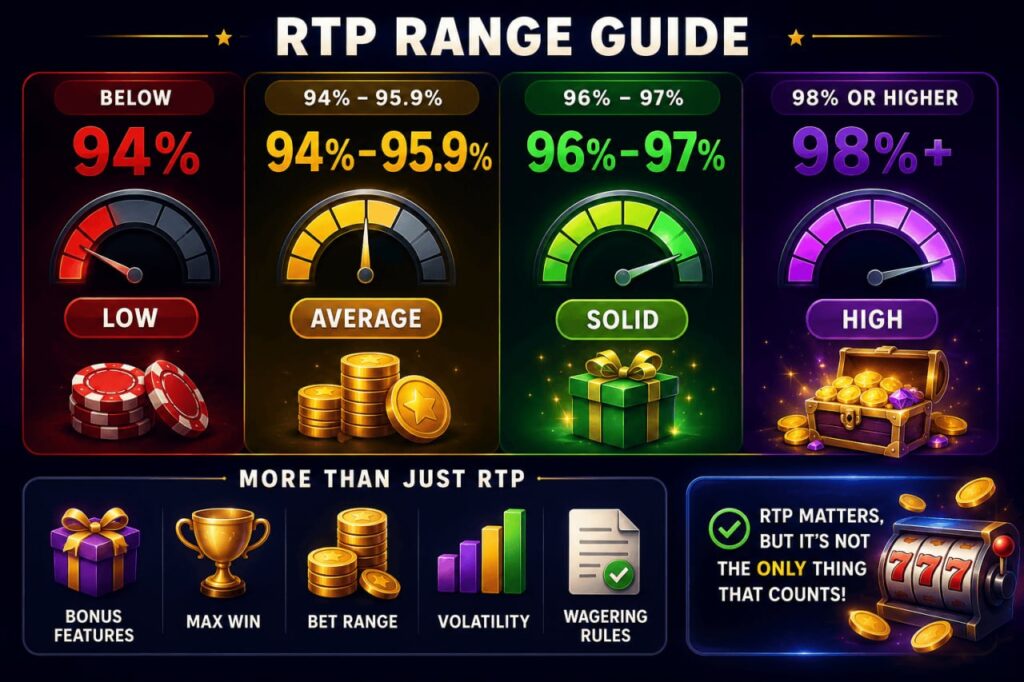
Still, a higher RTP does not automatically make a slot better. A 97% RTP slot with very high volatility can still burn through a balance quickly. A 95.5% RTP slot with lower volatility may feel smoother and give more frequent small wins.
Players should also look at the slot’s bonus features, max win, bet range, volatility and wagering rules if they are using a casino bonus. RTP is useful, but it should not be the only number that decides whether a game is worth playing.
Why Return Rates Do Not Guarantee a Win
The biggest mistake players make is thinking that RTP works like a refund system. A 96% RTP does not mean you can deposit €100, play for a while and expect €96 to come back.
RTP works across huge volumes of play, not across one user’s short session. The game can still produce long losing streaks, small wins, bonus rounds or large payouts. All of these outcomes are part of the slot’s math model.
This is why two players can have completely different results on the same slot. One may lose their balance in ten minutes. Another may trigger a bonus and leave with a profit. Both outcomes can happen even if the game has a fair and properly tested RTP.
A better way to understand RTP is this: it tells you how the game is built mathematically, but it does not tell you what will happen next.
Theoretical RTP vs Actual RTP
Theoretical RTP is the percentage built into the game by the provider. This is the number usually shown in the slot’s rules, paytable or information menu. It comes from the game’s math model and is tested before the game is released.
The actual RTP is different. It shows how much the game has really returned over a specific period based on real betting and payout data. For example, if players wager €1,000,000 on a slot in one month and the game pays out €950,000, the actual RTP for that period is 95%.
Actual RTP can move above or below the theoretical number in the short term. That does not always mean something is wrong. Random games can produce different results over days, weeks or even months. Over a much larger sample, the actual return should move closer to the theoretical RTP.
Why Volatility Also Matters
RTP is important, but it does not tell the full story. To understand how a slot may feel during gameplay, players also need to look at volatility.

Volatility shows how risky the slot is. A low-volatility slot usually gives smaller wins more often. A high-volatility slot may pay less often, but its bigger wins can be much larger. This is why two slots with the same RTP can feel completely different.
| Metric | What It Shows | Why It Matters |
| RTP | The theoretical long-term return of a slot | Helps compare expected return between games |
| Volatility | How often and how big wins may be | Shows whether the slot is more stable or more risky |
For example, a 96% RTP slot with low volatility may give frequent small wins and stretch the balance for longer. A 96% RTP slot with high volatility may feel colder, but it can offer larger bonus rounds or bigger max win potential. Same RTP, very different experience.
Where to Find Return to Player Rate in a Slot
Most online slots show RTP inside the game menu. The exact section depends on the provider, but players can usually find it without leaving the slot.
Common places to check include:
- Info;
- Rules;
- Paytable;
- Help;
- Game settings;
- Official provider page.
The most reliable place is usually the in-game rules section. Review sites can be useful, but they may show outdated numbers or list a different version of the same slot. If you want the exact RTP for the game you are about to play, check it inside that casino’s version of the slot.
Why the Same Slot Can Pay Differently
One thing many players do not know is that the same slot can sometimes have different RTP versions. The game title, graphics and bonus features may look the same, but the return percentage can vary depending on the version used by the casino.
This does not mean the casino secretly changes the game during play. In regulated markets, providers may offer pre-approved versions of a slot with different RTP settings. The operator then uses one of those versions.
The main takeaway is simple: do not assume that a famous slot has the same RTP in every casino. If you like a specific game, open the rules and check the number before playing. A small RTP difference may not change much in one short session, but it can still help you compare casinos and pick better slots for regular play.
How is RTP Tested?
RTP is not just a number added to the game rules. Before a slot appears in licensed casinos, its math model can be checked through theoretical analysis, simulations or both. Testing labs check the game’s math model, payout rules and simulations to make sure the stated RTP is accurate.
This is why licensed casinos usually work with certified providers and tested games. Published RTP, verified RNG systems and clear game rules help make the platform more transparent for players.
How to Make the Payout Percentage Work for You?
RTP is a useful number, but it only works as a long-term reference point. It does not predict one session, remove risk or guarantee profit. A 96% RTP slot can still produce losses, dry runs or very different results from player to player.
The best approach is to use RTP together with volatility, bonus features, max win, provider reputation and casino transparency. This gives a clearer picture of how the slot works before you start playing.
FAQ
What is RTP in casino?
RTP in casino means “Return to Player.” It shows the theoretical percentage of wagered money that a casino game may return to players over a long period. It helps compare games, but it does not guarantee a win.
What is an example of a slot’s payout percentage?
If a slot has a 96% return rate, it is mathematically configured to return approximately €96 for every €100 wagered over its entire lifespan. However, because this plays out over millions of spins, your short-term results can fluctuate wildly—meaning you could easily experience a massive win or a quick loss during your session.
Can RTP change after a slot is released?
Usually, a slot’s RTP does not change randomly after release. However, providers may offer several approved versions of the same game with different return settings. That is why the same slots can show different numbers in different online casinos.
Is higher RTP always better for players?
Not always. A higher RTP can be useful, but it does not automatically mean the slot is safer, easier to win on, or more enjoyable. Volatility, bonus frequency, bet size, max win and bankroll also affect the real playing experience.